Two numbers sit at the heart of this guide: 2.9% + 30¢ (what a card charge costs you in the US) and 0.8%, capped at $5 (what an ACH Direct Debit costs). On a $500 monthly subscription, that gap is $10.80 every single month — per subscriber, compounding silently in the background of your P&L. The obvious question is why everyone doesn’t switch, and the honest answer is the rest of this article.
We explained ACH itself back in our ACH payments guide — the rails, the terminology, the mechanics. This one is the decision version: the cost math at real subscription sizes, what you give up for the savings (speed, certainty, and one bit of customer friction), the middle path Stripe offers, and a clear answer on who should steer recurring revenue to bank debits and who should leave it on cards.
The cost math at real subscription sizes
Both rates come from Stripe’s pricing page: cards at 2.9% + 30¢ for US domestic transactions, ACH Direct Debit at 0.8% with a hard $5 cap. Run them against the monthly amounts recurring businesses actually bill:
| Monthly charge | Card cost | ACH cost | You save, per subscriber per month |
|---|
| $25 | $1.03 | $0.20 | $0.83 |
| $50 | $1.75 | $0.40 | $1.35 |
| $100 | $3.20 | $0.80 | $2.40 |
| $500 | $14.80 | $4.00 | $10.80 |
| $1,000 | $29.30 | $5.00 (cap) | $24.30 |
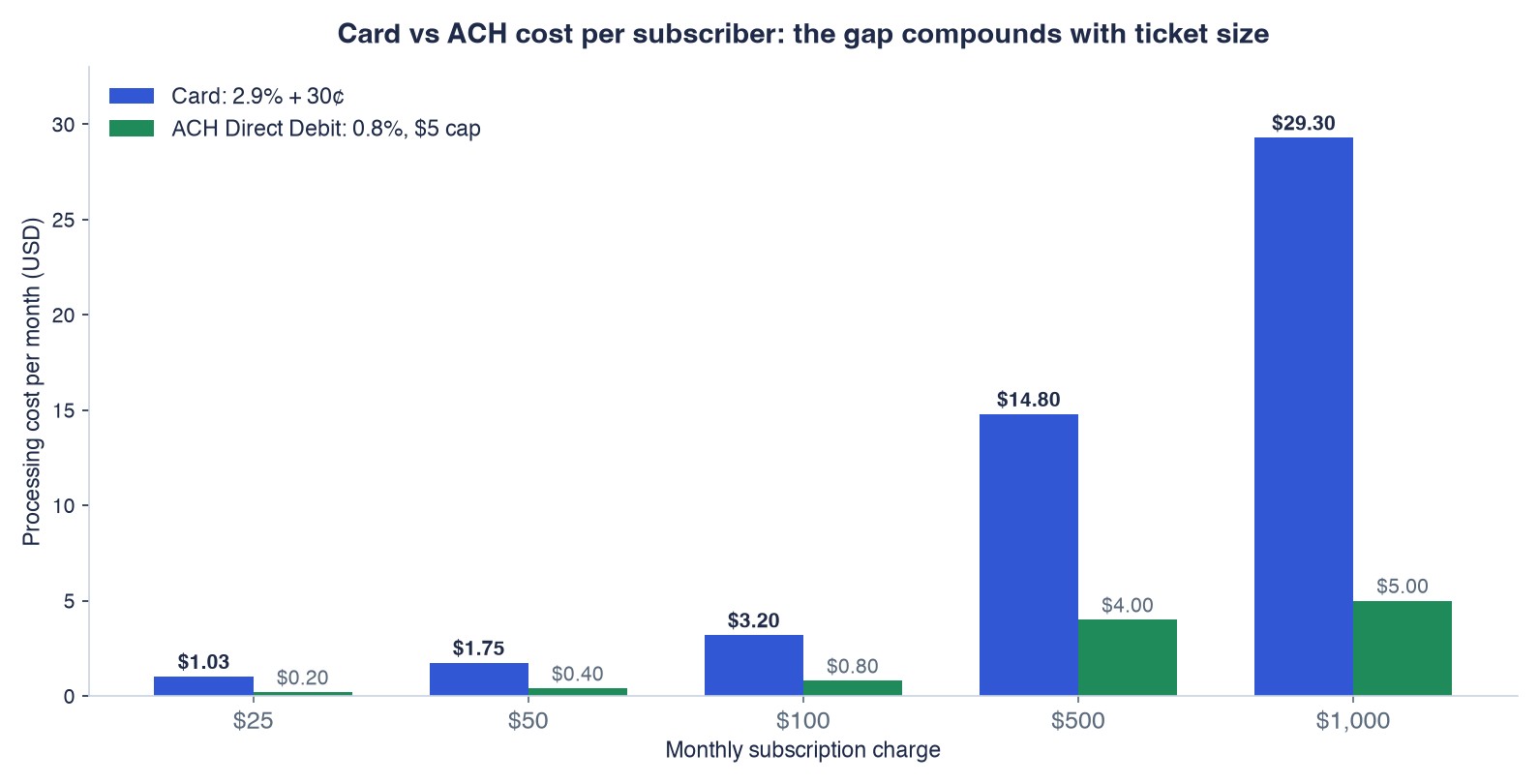 Card vs ACH cost per subscriber at five monthly charge sizes: the gap compounds with ticket size
Two things to notice in that column. First, ACH is cheaper at every price point — the percentage gap is structural, not a volume threshold you have to reach. Second, the $5 cap changes the shape of the savings: it bites at $625, so everything above that is effectively a flat nickel-and-dime fee. A $2,000 B2B retainer costs the same $5 to collect as a $625 invoice. With 200 subscribers at $500/month, the table says $2,160 a month, $25,920 a year. That’s not optimization; that’s a headcount.
The cap also hands you a billing-design lever most people miss: above $625, the ACH fee stops growing. A $1,200 annual plan charged once costs $5.00 flat on ACH (0.4% effective) — while twelve $100 monthly charges cost $9.60 across the year, and the card version of that annual charge is $35.10. If you have annual-plan customers, annual billing on bank debit is the cheapest of the methods compared in this guide: one flat $5 per customer per year, full stop.
What you give up for the savings
If the math were the whole story, cards would be dead. It isn’t, and the trade-offs are real — per Stripe’s ACH documentation:
- Settlement is slow. ACH Direct Debit runs T+4 as standard — four business days before funds land (a faster T+2 tier exists for eligible US accounts, check your payment-methods settings). Cards look instant by comparison, and if your business runs on weekly payouts, you’ll feel the lag — worth reading alongside our payout-schedule guide so the two clocks don’t surprise you in the same week.
- It’s not a guaranteed payment method. You can wait up to 4 business days just to learn whether the debit succeeded or failed. A card tells you in seconds; ACH tells you on Thursday. For a subscription, a silent failure discovered four days late is four days of service delivered on a bounced payment — which is why the instant-confirmation alternative shows up later in this guide.
- Disputes exist on ACH too. Bank debits can be returned/disputed through the customer’s bank — different mechanics than card chargebacks, but not immunity. And remember from our refunds guide: bank-debit refunds carry the double-credit trap if a dispute and your refund race each other.
- Verification is friction. Bank accounts must be verified before debiting. That’s either an instant check (priced per successful verification — $1.50 each on US pricing) or free micro-deposits, which cost the customer a small chore and a wait — Stripe gives customers a 10-day window to complete them. Cards ask for sixteen digits and go — which is exactly why the method choice is a conversion decision, not just a cost one.
None of these are reasons to stay on cards at any price. All of them are reasons to choose deliberately per business model instead of flipping a global switch — and one of them (the expiry point) is about to get its own section, because it quietly reverses part of this list.
The failure-rate question cuts both ways
Before assuming cards win on reliability, look at why recurring card payments actually fail: expirations, reissues, spending limits, issuer risk declines. Our guide to failed recurring payments is essentially a catalog of cards dying slowly in your subscriber base — every expiry cycle is an involuntary-churn event your dunning has to chase.
Bank accounts don’t expire. There’s no card number to reissue, no CVC to rotate, no network token to refresh, no “card ending in 4242 is about to expire” email sequence to maintain. A subscriber who pays by bank debit simply doesn’t generate the slow-drip failure events that card portfolios produce every month. So the honest failure comparison isn’t “cards reliable, ACH risky” — it’s that cards generate a recurring, predictable drip of expiry-driven failures, while bank debits have no expiry to shuffle. Different failure shapes, not different failure existence. For a recurring business, the method you retry matters less than how much retrying you have to do, and that’s a structural point for bank debits that the fee table doesn’t even count.
The middle path: Instant Bank Payments
Stripe knows the trade-off hurts, so there’s a third option worth knowing exists: Instant Bank Payments, available as part of Link. It moves the money on bank rails with a card-like instant flow — confirmation is instant (no 4-day cliff), and bank-initiated returns are guaranteed by Stripe, which takes the late-failure risk off your books. The cost sits between the two: 2.6% + 30¢ on US pricing, under the card rate but well above the ACH 0.8%-capped structure — a premium for the certainty. Whether that premium beats the residual risk depends on your ticket size and how painful a failed $500 debit is to your month.
Who should steer subscribers to bank debit
The decision, in one framework:
- Strong yes: high-ticket recurring. Retainers, B2B SaaS, agency plans, $200+/month memberships. The cap makes the fee trivial, your clients already think in bank transfers, and a day of verification friction at signup is nothing against a year of savings multiplied across every seat they pay for.
- Strong yes: churn-resistant bases. If your subscribers are annual, sticky, and relationship-heavy, the 4-day failure window rarely bites — and when it does, you know the customer well enough to call them. The inverse is worth respecting too: a transactional, anonymous, high-churn audience is exactly where a late-discovered failure costs you service you can’t claw back.
- Mixed: mid-price consumer subscriptions ($20–$100). The savings are real but per-subscriber small (roughly $0.70–$2.40/month). Offer bank debit as a highlighted option rather than the default, and let the savings compound on whoever opts in — a “pay by bank” line at checkout costs you nothing and quietly converts the fee-aware slice of your audience.
- Probably not: impulse-priced consumer products. Below ~$20/month, the per-subscriber saving is pocket change, signup friction costs you conversions at the worst possible moment (the very first one), and a consumer audience bounces micro-deposit verification straight into abandonment. Keep cards here, and revisit when your average ticket or your margin pressure changes.
And the hybrid most real businesses land on: cards as the default for speed and conversion, bank debit offered and gently incentivized for the plans where the fee gap is material. This is a pricing-page design decision more than a payments one — which is exactly why it belongs in the same conversation as our subscriber migration playbook: the method you move people to matters as much as the platform.
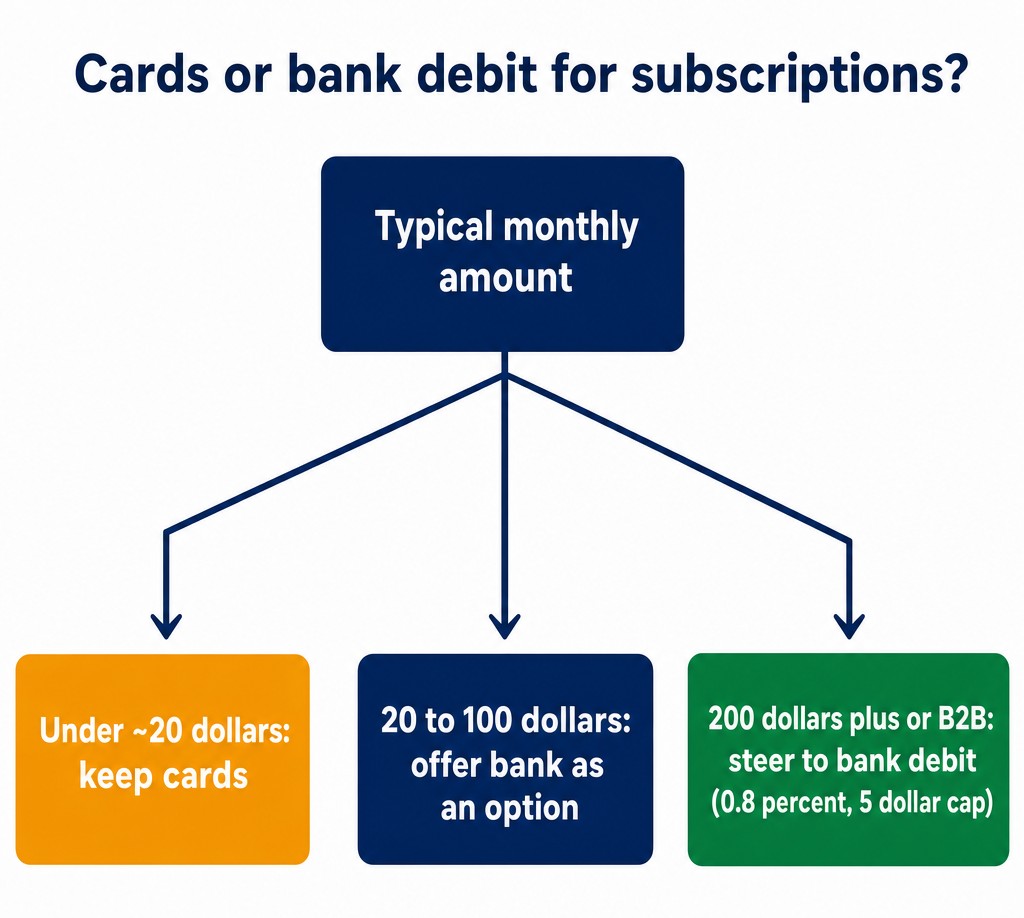 Cards or bank debit for subscriptions: the decision by typical monthly amount
Run it as a pilot, not a leap
However good the math looks, don’t flip your whole base on a spreadsheet. The sane rollout: add the bank-debit option to new subscriptions first (highest-ticket plan if you have tiers), give it one full billing cycle, and read four numbers: opt-in rate, first-payment success rate, late-failure rate, and support tickets mentioning “bank.” If opt-in is healthy and failures are boring, extend it to renewals and consider a small incentive for switching saved cards to bank accounts — a one-time credit that costs less than two months of the fee gap pays for itself fast at these spreads.
What you’re watching for in the pilot isn’t failure — it’s weirdness: verification drop-offs, customers confused by pending debits, timing collisions with your payout expectations. Those are all fixable with copy and process, but you want to meet them on fifty subscribers, not five thousand.
Bottom line
ACH Direct Debit is structurally cheaper than cards at every price point, and above the $625 cap it’s absurdly cheaper — but you pay for it in settlement speed, payment certainty, and a verification step at signup. High-ticket and B2B recurring revenue should move to bank debits as soon as practical; impulse-price consumer subscriptions should stay on cards; everyone in between should offer the option and let the savings compound. Full disclosure: WP Full Pay is our plugin, and whichever methods you offer, the math above is the same — check your actual Stripe pricing for your region, then run your own subscriber sizes through the table — five minutes with your real numbers will tell you which bucket you’re in more honestly than any guide, this one included.
Sources