Building a full storefront is unnecessary when the immediate goal is to collect payment for one clear offer. Stripe Payment Links turns that offer into a reusable URL that opens a Stripe-hosted checkout.
The fast setup is the appeal, but it also creates tradeoffs. The checkout has limited design flexibility, payment methods vary by eligibility, and a reusable link is not a complete product catalog or customer workflow.
This guide explains how Payment Links work from creation through fulfillment, which capabilities need careful configuration, and when a WordPress payment form is the better fit.
What are Stripe Payment Links?
A Payment Link is a URL connected to a configured product, price, or customer-chosen amount in Stripe. When someone opens it, Stripe creates a checkout session and displays a hosted payment page. The same link can be shared with many customers unless you deactivate it or set a payment limit.
Stripe describes Payment Links as a no-code product with limited checkout customization, preferred-language rendering, automatic receipts, and support for more than 40 payment methods. That method count describes the product’s overall capability, not what every customer will see.[1]
📖 Similar name, different job: Link by Stripe is an accelerated checkout service that can reuse customer information. A Payment Link is the shareable checkout URL itself.
How to create a Stripe Payment Link
1. Choose a pricing model
Start in the Stripe Dashboard under Payment Links, then create a new link. Stripe separates the setup into two broad models:
- Products or subscriptions: Select an existing product and price, or create one during setup. This model supports one-time and recurring prices.
- Customers choose what to pay: Set a title and optional suggested, minimum, or maximum amount for donations, tips, or flexible pricing. Stripe says this model does not support recurring payments or recurring donations.[2]
Choose the model before polishing the checkout. Changing a fixed-price campaign into a subscription or a customer-entered amount later can affect the offer, reporting, and fulfillment logic.
Review the product, quantity rules, customer information, billing or shipping address, payment methods, and post-purchase behavior. Add only the fields needed to deliver the product or meet a clear business requirement. Extra fields create more work for the buyer and more personal data for the business to handle.
Promotion codes, optional items, purchase limits, terms acceptance, and automatic tax collection can be configured for suitable links. Automatic tax uses Stripe Tax, which is a paid product and requires the business to configure its registrations. These controls are not a substitute for tax or legal advice.[3]
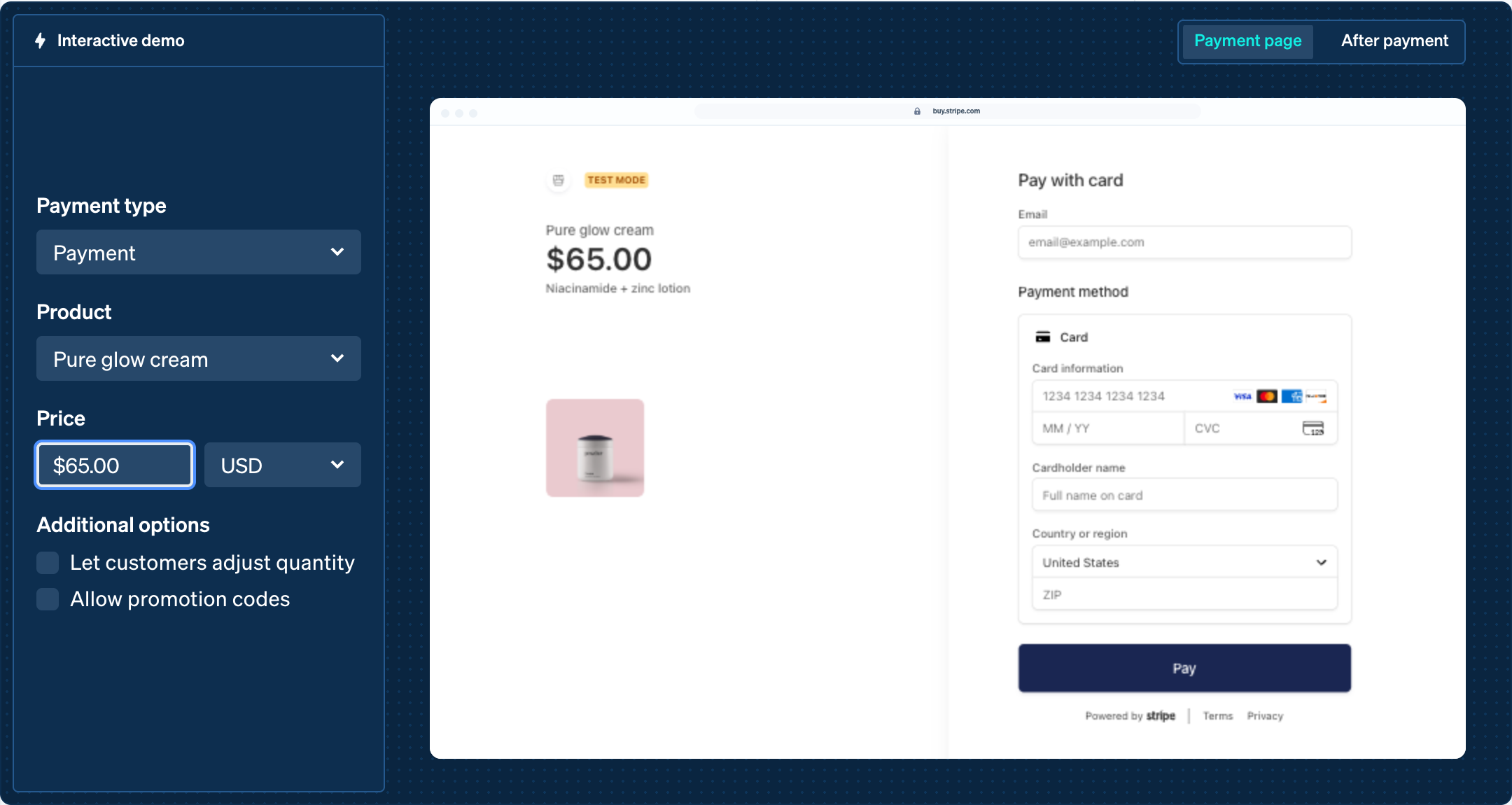 Stripe’s current official demo pairs the configuration controls with the resulting hosted payment page.
3. Preview and create the link
Use the preview to check the product name, amount, call to action, required fields, policy links, and mobile layout. Confirm that test content contains no real customer information, then create the link and run a test payment before sharing it publicly.
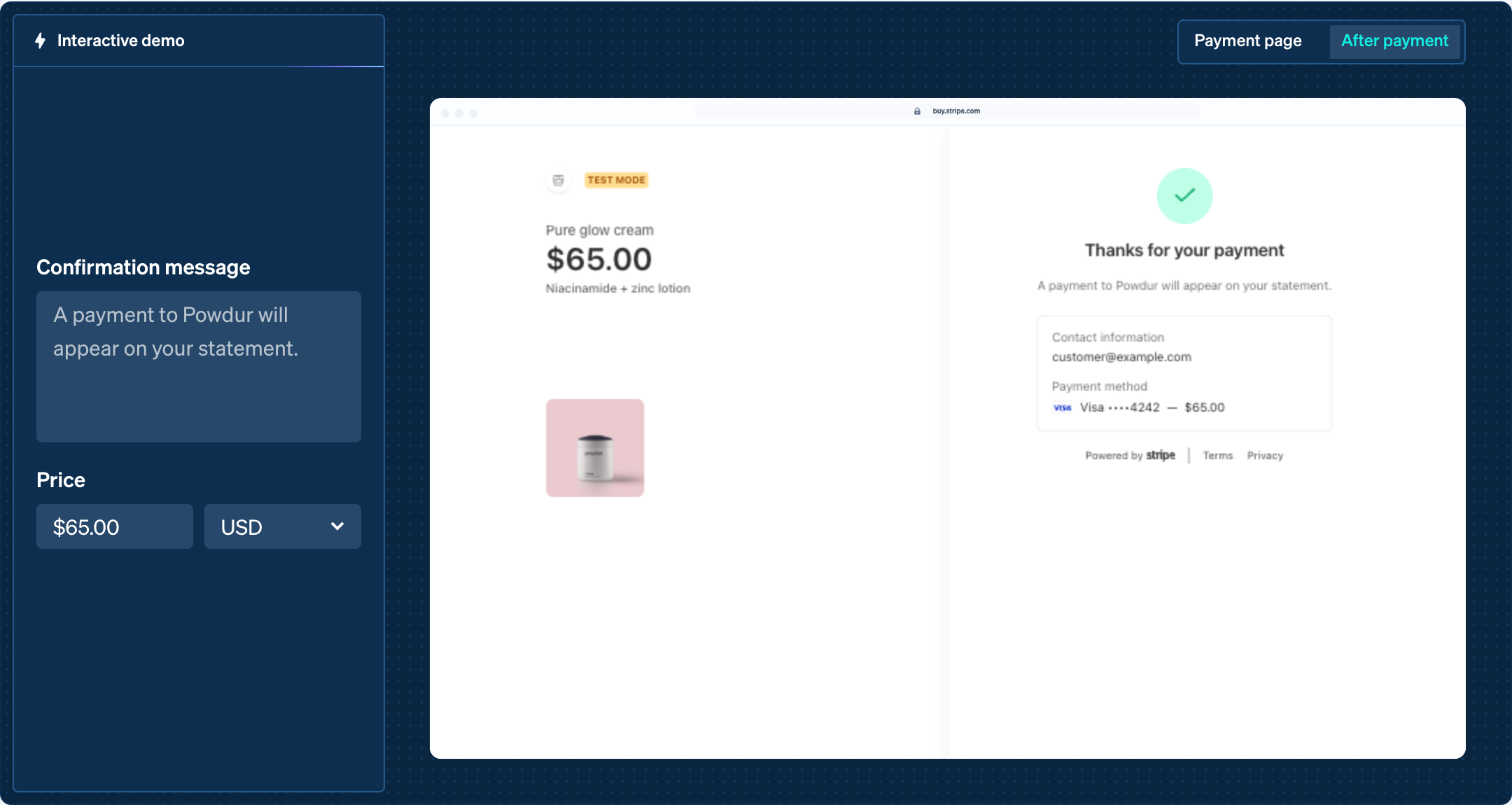 The same official demo shows the confirmation state after a successful test payment.
4. Share or embed the link
Copy the URL into an email, text message, social post, support conversation, or campaign page. Stripe can also generate a QR code or an embeddable buy button from the same link. The QR code itself does not expire, but it leads to an expiry page if the underlying link is deactivated.[4]
Use direct sharing when the offer needs little explanation. Use the buy button when a page already provides the product details and only needs a clear route into checkout. Deactivate the link when the offer ends, or set a purchase limit when inventory or access is intentionally restricted.
What Payment Links can handle
| Capability | What to know before launch |
|---|
| One-time sales | Use a fixed product and price, quantity controls, or a customer-chosen amount where supported. |
| Subscriptions | Use a recurring Stripe price. Customer-chosen amounts do not support recurring payments. |
| Payment methods | Stripe selects compatible methods dynamically. Display can vary by account, country, currency, amount, browser, device, and customer. |
| Discounts and extras | Promotion codes, optional items, and upsells can be enabled where the link and account support them. |
| Branding | Apply a logo, colors, fonts, shapes, policies, and contact details, but expect less design control than on a normal web page. |
| After payment | Show a confirmation, redirect to a URL, send enabled receipts, and review payments. Views, sales, and revenue metrics are available only for eligible links without recurring prices. |
Payment method availability deserves a deliberate test plan. A wallet can depend on the customer’s device and browser, while bank debits and vouchers can confirm later than cards. Test the currencies, markets, devices, and payment types that matter to the business instead of assuming the preview represents every buyer.
The Payment Links lifecycle after checkout
A payment page is only the front of the process. Decide what should happen after a customer submits it:
- Confirmation: Stripe shows a localized message or redirects the customer to a chosen URL.
- Receipt: Stripe can send an automatic receipt when the account settings and payment status allow it.
- Tracking: The Dashboard shows payments. For eligible links without recurring prices, the Payments and analytics tab also shows views, sales, and revenue. Subscription links require payment and subscription records instead. URL parameters and campaign tags can help distinguish traffic sources.
- Fulfillment: A person can fulfill from Dashboard records, or an integration can respond to Stripe events.
Stripe documents payment tracking, confirmation messages, redirects, receipts, invoices, and link metrics as separate post-payment controls. Metrics can be delayed by up to 18 hours, are unavailable in sandbox, and are not supported for links that include recurring prices.[5] Keep the thank-you page focused on customer guidance, not on proving that an asynchronous payment has cleared.
💡 Fulfillment rule: For automated delivery or access, Stripe says to use webhooks so the system can process every completed payment. A browser redirect can fail or happen before a delayed payment method reaches its final status.[6]
Limits to plan around
- Anyone with the URL can open it: A shared link is not a private quote or an authenticated customer area. Deactivation and payment limits control use, but they do not turn the URL into identity verification.
- Customization is intentionally bounded: Branding options can make the checkout recognizable, but the hosted page is not a free-form landing page.
- Each link represents a configured offer: A growing catalog, comparison flow, account area, or complex cart may need a broader commerce setup.
- Eligibility changes what customers see: Payment methods and wallets are not universal, even when they are enabled in the account.
- Operations still matter: Refunds, disputes, taxes, inventory, delivery, support, and subscription management do not disappear because checkout was quick to create.
Stripe Payment Links vs WP Full Pay
WP Full Pay, the WordPress Stripe plugin featured on this site, is useful when the payment experience should live in a WordPress page rather than exist mainly as a shared URL.
| Decision | Stripe Payment Links | WP Full Pay |
|---|
| Fastest starting point | Create a hosted page in Stripe and share it without a website. | Install and connect a WordPress plugin, then configure and place a form. |
| Placement | Customers pay on a Stripe-hosted page. | Choose inline fields on the WordPress page or a button that redirects to Stripe-hosted Checkout. |
| Offer context | Limited checkout copy and branding. | Surround the form with the page’s own product copy, media, FAQs, and navigation. |
| Form models | Fixed-price products, subscriptions, or a customer-chosen one-time amount. | One-time, donation, subscription, and save-card forms, with supported settings varying by form type. |
| Business fields | Stripe checkout fields and a small custom-field set. | Up to 10 custom fields per form, plus billing, shipping, email, redirect, and notification options. |
| Sharing | Native reusable URL, QR code, and buy button. | Share the WordPress page URL or place the form around the site. |
Current WP Full Pay documentation lists one-time, donation, subscription, and save-card forms, along with shared features such as custom fields, email notifications, and redirects.[7] Its layout guide distinguishes inline forms from Checkout forms that send the customer to a Stripe-hosted page.[8]
This comparison is about workflow and page ownership, not a claim that one checkout is universally safer or converts better. Payment Links is often the cleaner choice for a quick campaign, a QR code, a payment request in a conversation, or an offer that does not need a website. WP Full Pay is the stronger fit when the page content, form placement, WordPress data, and post-payment path need to work together.
📖 Building on WordPress? See how to sell products without WooCommerce when a focused payment form is enough.
Stripe Payment Links decision checklist
- Is the offer simple enough to describe before the customer opens checkout?
- Does the business need a fixed price, recurring price, or customer-chosen one-time amount?
- Which countries, currencies, devices, and payment methods need testing?
- Who handles fulfillment, refunds, disputes, subscription questions, and failed payments?
- Should customers return to a specific page, receive a receipt, or trigger an automated workflow?
- Would a full WordPress page provide useful context that the hosted checkout cannot?
Stripe Payment Links FAQ
Is Stripe Link the same as Payment Links?
No. Stripe Link helps eligible customers reuse information saved with Stripe. Payment Links creates a reusable checkout URL. Link can appear as an accelerated payment option inside that checkout.
Do Stripe Payment Links expire?
A QR code generated for a Payment Link does not expire on its own. The underlying link can be deactivated or can deactivate after reaching a configured payment limit, which prevents new purchases through that URL.
Can Payment Links collect subscriptions?
Yes, when the link uses a recurring Stripe price. The customer-chosen-price model is for one-time payments and does not support recurring payments or recurring donations.
Can a Payment Link be added to WordPress?
Yes. Add the URL to a normal button or use Stripe’s generated buy-button code where the site allows it. If the payment fields or business-specific form data should live directly on the page, use a WordPress payment form instead.
How do you confirm a Payment Link payment?
Review the payment status in Stripe. For automated fulfillment, process the relevant Stripe events and make the workflow safe to run more than once. Do not use a customer reaching the return page as the only proof that every payment has cleared.
Choose the right payment path
Stripe Payment Links is a practical way to launch a focused offer quickly, share it almost anywhere, and let Stripe host the checkout. Its simplicity works best when the offer, customer path, and fulfillment rules are also simple.
When the sale depends on richer page content, site-native fields, or a WordPress-centered workflow, move the payment experience into a dedicated form. In either case, test the full journey with the payment methods and post-payment actions the business actually expects to use.
References
- Stripe documentation: Payment Links overview and availability
- Stripe documentation: Create a payment link
- Stripe documentation: Customize Payment Links checkout
- Stripe documentation: Share a payment link
- Stripe documentation: After a Payment Links payment
- Stripe documentation: Fulfill Checkout and Payment Links orders
- Themeisle documentation: WP Full Pay form types
- Themeisle documentation: Inline and Checkout form layouts